My name is Brian Dobosh.
I am 23 years old.
I am a research associate,
more commonly referred to as a lab tech
at the Weiss Lab for Synthetic Biology at MIT
and I make $47,000 a year.
Synthetic Biology is really an interface
of many different fields.
Biology, chemistry, physics, electrical engineering,
computer engineering, chemical engineering.
So it's all of these different fields coming together,
bringing their expertise, to tackle a biological problem.
We're trying to induce systems
or processes in cells within the body
that we don't have naturally.
For example, for some chronic disease,
you might take a pill every single day.
Instead of taking a pill every day,
maybe we'll just give you an injection once a month.
And that can be a lot cheaper, less manual labor
on the patient.
That could be a lot better.
So in the Weiss Lab, there's definitely
a very defined hierarchy.
And this would change from lab to lab,
but in general you have your PI,
which is your Principal Investigator,
the person in charge.
And underneath them, they have a group of post docs.
Post doc meaning people who have their Phd
and are doing something right after.
Practiv for running their own lab, perhaps.
And then you also have graduate students,
people in the process of getting their master's or Phd.
And then you also have lab techs,
or research associates.
We talk back to the post docs, the Principal Investigator,
and some of the grad students,
and assist them with their work.
Doing a lot of the day to day tasks.
Lab techs I would say are generally either undergrads
or people have recently graduated.
But you do have some lab technicians
that are also having that as their career.
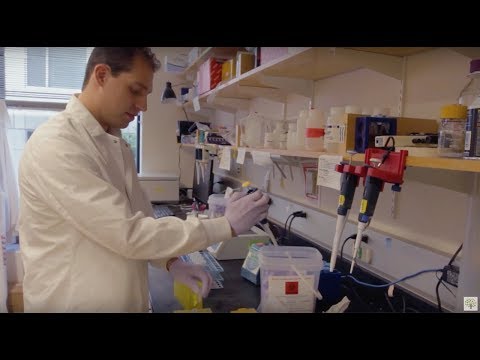
As a lab tech I spend most of my time
within the lab doing wet work.
Moving liquid from tube to tube
such as enzymes, DNA, RNA, using a pipette
which is a liquid handler
that could handle very small amount of liquid.
I also am part of EHS,
which is Environmental Health and Safety,
and making sure that we're up to compliance
and talking to the proper people
about managing our hazardous waste,
where that goes, and other safety regulations.
Some of my main responsibilities
in more science terms, I will clone DNA
which are the blueprint and then
from DNA I will make RNA.
And from RNA you will transfect that into cells
which will then make a protein product
which you can measure using a few different instruments.
And once you collect that data,
you'll analyze it and then present it
in such a way that other people can understand it
and then because this is an engineering lab,
you then take that data that you got
and you back to the design step.
Because nothing is ever perfect in science
or anything else.
And so you see what happened
and you try and make it better.
And you keep on doing this iterative design cycle
until you get a product that you're happy with.
If there's a structural defect
in, maybe, your heart.
There's a valve missing, perhaps.
A lot of times you'll have surgery
that can replace that but the hope
for the future is that maybe we can put
in stem cells that know how to reorganize themselves
and can create a portion of that organ again.
Which could be a lot safer, easier,
than our current methods, non-invasive perhaps.
But one of the things that I like about science
is that it's a puzzle and so you have
to be wanting, really enjoy a problem solving mindset.
And you have to be curious about what's going on.
You can't just tackle a problem without caring about it.
And you have to be voracious for knowledge,
really wanting to learn as much as you can,
understand what is going on,
and then of course you have to communicate
with other people, so you have
to be good at talking and be able
to communicate with otherS effectively.
Definitely in addition to communication
you should certainly be a good listener as well.
Because not only do you have to communicate your ideas
or your data, but you have to listen
to the data and ideas from other people
so that you cannot only learn from them
but incorporate that into your own designs
and youR own work.
And then additional skills are always,
if you have more programming knowledge,
that's always a plus cause that could help
with being able to analyze data.
If you have a digital arts background,
making figures and graphs appealing
to the eye and easy to communicate data with
is incredibly important.
And actually a lot of scientists lack the ability.
My first time when I got into a lab was in high school
and at the time I had no idea
what a lab environment was like.
I had never worn a lab coat before.
I had never touched a mouse.
I was a little bit squeamish about that at first.
And so there's definitely a whole new series
of experiences that you would never get
just growing up.
And it was a lot to take in at first
but hopefully if you're in a good lab environment,
your mentor and the other people around you
will be understanding and willing to help.
Yeah, I've definitely made a lot of mistakes.
I remember when I was in undergrad,
I was working in this one lab.
We have an instrument that is able
to control temperature really well.
So if you have a reaction that requires
a particular temperature to work at
that's not just room temp, you use this machine.
When I set up this machine, I had my notebook
right next to it, a physical notebook.
And the machine turned on and the fans go
but you have to exhaust all the heat
that you're generating.
And my notebook page went up on top
of the machine, covered the fan,
and everything started smoking up.
And that was one of my first experiences with,
oh my goodness, what have I done.
Cause I ruined the machine which is not a cheap one.
Overall people are understanding.
People both get very invested in their experiments
so when someone else screws it up,
it can be difficult.
But part of science is understanding
that things can go wrong
and it's not anyone's fault necessarily.
So when I was applying for this job,
I definitely was aware of the range
of salaries that I could be getting.
And when I was hired, I was hired
at $40,000 a year, and then there was a proposal
by the National Institute of Health, NIH,
for people on an RSA grants to make a higher amount.
And so when that was proposed, MIT raised the salaries
of all lab techs and post docs to that amount
that was later overruled, but MIT has kept it at that.
So if you stay on, at MIT, if you stay on
as a lab tech, you do annually get a raise
but in small increments.
And in an academic environment,
there's definitely a ceiling that can be tough to breach.
But there are ways around it.
I've seen a lot of people go
from a lab tech role into maybe an EHS advisory role.
Or becoming lab managers later on in their careers.
But in academia there's definitely a ceiling
that can be tough to reach without a higher degree,
as a master's or Phd.
Industry labs, or government positions,
you can make a little bit more
than you do in academia.
Maybe upwards of 70 or 80,000 a year.
Working in a lab can be incredibly fun
and also frustrating.
Because you're solving a problem,
or attempting to solve a problem,
that no one else has tackled before,
or has really had an answer to.
You're doing something that no one else has done before
and that's a really cool thing for me.
It makes sense that would also be incredibly frustrating
because, if you're solving something so difficult,
well there's a reason it's difficult.
You're gonna experience a lot of failure,
a lot of issues, along the way.
And so it's both good and bad being in that lab.


Không có nhận xét nào:
Đăng nhận xét