ROBERT COSTA: President Trump downplays disagreements over intelligence and declares no
wall, no deal. I'm Robert Costa. Welcome to Washington Week.
President Trump tells his intelligence chiefs to go back to school following their stark
assessment of threats from North Korea -
DIRECTOR OF NATIONAL INTELLIGENCE DAN COATS: (From video.) North Korea will seek to
retain its WMD capabilities and is unlikely to completely give up its nuclear weapons and
production capabilities.
ROBERT COSTA: - ISIS -
DIRECTOR OF NATIONAL INTELLIGENCE DAN COATS: (From video.) ISIS is intent on resurging
and still commands thousands of fighters in Iraq and Syria.
ROBERT COSTA: - and Russian interference.
FBI DIRECTOR CHRISTOPHER WRAY: (From video.) Not only have the Russians continued to do
it in 2018, but we've seen indication that they're continuing to adapt their model and
that other countries are taking a very interested eye in that approach.
ROBERT COSTA: Plus, the president calls bipartisan border talks a waste of time.
We cover it all next.
ANNOUNCER: This is Washington Week. Once again, from Washington, moderator Robert Costa.
ROBERT COSTA: Good evening. There were cracks this week between President Trump and
intelligence leaders, and between the president and fellow Republicans.
By an overwhelming bipartisan vote, the GOP-controlled Senate opposed the president's
plan to withdraw U.S. forces from Syria and Afghanistan.
Peter Baker wrote this week that, quote, "the disconnect between President Trump and the
Republican establishment on foreign policy has rarely been as stark." The move by
Majority Leader McConnell comes as the president also diverged from his intelligence chiefs.
Joining me tonight are Peter Baker, chief White House correspondent for The New York
Times; Bob Woodward, Pulitzer Prize-winning reporter, author, and associate editor at The
Washington Post; Shawna Thomas, Washington bureau chief for Vice News; and Nancy Cordes,
chief congressional correspondent for CBS News. Bob, welcome back to Washington Week.
BOB WOODWARD: Thank you.
ROBERT COSTA: Watching those clips of Director of National Intelligence - Director of
National Intelligence Dan Coats, we see all these assessments, all these conclusions, yet
there's this gap between them and President Trump. Why is there a gap?
He's getting the daily brief from these leaders every day.
BOB WOODWARD: Yes, and of course the intel community is in many ways a priesthood, and
it's a closed system. And, in fact, at the CIA they call the president the "first
customer" and everything is to be funneled to him.
And then to have the president - commander in chief, the "first customer" - kick them so
hard and say you need to go back to school, you're naive, is insulting, and as we find in
the Trump presidency, it's not in Trump's own interest. Even if he feels that, he
should call them in and say, hey, guys, go back to school, or something like that.
And as we are just a little month or at some point there's going to be a Trump-Kim
Jong-un summit again, you can't go into that divided, and you've got to have some
knowledge about why does North Korea have nuclear weapons.
They have nuclear weapons because they believe it's a deterrent and it gives them
leverage in a very important way. And the intel people have been telling Trump for a
long time, hey, they're not going to give up their nuclear weapons. So there's a divide.
ROBERT COSTA: Shawna, you were there in Singapore during the last Kim Jong-un-President
Trump summit. What does what happened this week mean for the next one this month?
SHAWNA THOMAS: I mean, I think - the thing is, the president wanted to do that summit.
He clearly said it over and over again, and they made that summit happen for him.
He has said he wants to do another one. The reporting out there and what we're hearing
from our international partners is that it's probably going to be in Vietnam.
If he wants to do it, he has an entire infrastructure to make another one happen.
And clearly, Kim wants to do it as well. So I think we're going to see another summit.
I think the question about what the intelligence chiefs were saying versus what
President Trump was saying, we also have the added problem that is confusing to our
foreign partners: What do we actually believe? What is actually true?
Should we believe anything that the ambassadors or anyone else tells them if the
president is saying that?
How do you make any decisions in the world if you really do not know what America wants?
ROBERT COSTA: What did you learn, Peter, when you sat down with your colleague Maggie
Haberman with the president in the Oval Office this week?
Is he isolated from his own intelligence officials?
PETER BAKER: Well, he told us no, that he had brought them in and everything turns out
to be fine. The only problem was the media, of course, misinterpreted what the
intelligence chiefs had to say; that's what he told us.
What's really fascinating about the way he described the conversation he had with them,
though, was how he operates and how the people around him operate, right?
He brings in Dan Coats, the director of national intelligence; Gina Haspel, the CIA
director; he says, I understand, he says, you're going out there saying Iran is a
wonderful place. Iran's not a wonderful place. And they say, sir, we don't think
Iran is a wonderful place and, you know, we've been misinterpreted.
He says, well, then, therefore, the media misinterpreted.
They never said, of course, that Iran was a wonderful place, nor did we say that.
SHAWNA THOMAS: And neither did - neither did the media, yeah.
PETER BAKER: Neither did the media.
We reported correctly that they said - and everybody saw live on television themselves -
was that they said Iran isn't currently building a nuclear weapon.
And the president sort of has created this strawman, in effect, where he says, well, they
didn't say this thing - which they never said - therefore, it must be the media, and now
everything's fine. And it's interesting because it talks about how the president
lives in his own space and the people around him are trying to, you know, keep him,
you know, happy, more or less, without having to sacrifice the - what the professionals
tell them at Langley and across the CIA and across the intelligence network.
SHAWNA THOMAS: Also, we're not talking about the big thing that actually got talked
about in that hearing, which was the cyber threats.
PETER BAKER: Yeah, exactly.
SHAWNA THOMAS: The cyber threats from China, the cyber threats from Russia, because
we're litigating did they say what they said because - we heard them say it.
And that is - that's going to affect this election, that's going to affect our - it could
affect our power grids, it could affect so many other things, and we don't have room for
that conversation for some reason.
ROBERT COSTA: You had a(n) exchange, Nancy, with Senate Majority Leader McConnell about
all of this. What has been the reaction among Republicans on Capitol Hill as
they watch this president handle his own intelligence community this way?
NANCY CORDES: Well, he claimed to have no idea what had happened in the hearing.
In fairness, I did ask him about it on the day of the hearing. But, you know, this is
something that was all over the news. It was being talked about in the halls of Congress.
So the notion that he was unaware that the president's hand-picked intelligence advisors
were saying something so markedly different from what the president has said in the past
is somewhat not believable.
I think another thing that got buried in that hearing was something very striking that
the intelligence advisors all said, which is that at the same time that Russia and China
are more united than they have been since the 1950s, U.S. allies are pulling away from
us, and the reasons they cited for that are because of U.S. policies on security and trade.
Those are the president's policies, and it's a pretty striking indictment coming from his
own top intelligence officials.
BOB WOODWARD: But what can cripple Trump in this is he goes to a summit with Kim Jong-un
and he has this expectation, oh, I can get him to give up his nukes, and he doesn't.
And beware of somebody like Trump when he is disappointed and when he feels somebody has
pulled the rug out from under him, and even if he's been told by the world and his
intelligence people don't expect that.
Look, North Korea is there for - it gives him tremendous leverage.
Countries don't give up nuclear weapons. Libya did, and look what happened there.
ROBERT COSTA: And the Democrats were pretty alarmed by all this.
Senate Minority Leader Chuck Schumer released an open letter to intelligence officials
urging them to hold an intervention for the president.
Schumer wrote in part, quote, "You cannot allow the president's ill-advised and
unwarranted comments today to stand. He is putting you and your colleagues in
an untenable position." And Speaker Pelosi responded this way.
HOUSE SPEAKER NANCY PELOSI (D-CA): (From video.) The president just doesn't seem to have
the attention span or the desire to hear what the intelligence community has been telling him.
ROBERT COSTA: Bob was talking about how North Korea sees its own deterrence with its own
nuclear arsenal, but what about the rest of the world, talking about the U.S.'s role in
it? How do they see these tensions between the intelligence officials and President Trump?
PETER BAKER: Well, for instance, in Moscow you hear Vladimir Putin basically playing to
President Trump's own distrust of his agencies, right?
This is built on a fact that two years or more of a suspicion between President Trump and
these organizations, which started his presidency by telling him that his election was
not valid, in effect, that's the way he sees it. They came to him, said, Russia influenced
the election. And his mind, it questioned his very legitimacy as president.
He didn't trust the ones who came to them then. They were the Obama appointees.
He doesn't trust the ones who are coming to him now, even though he appointed them.
And his deep state idea has created a gulf between them. And his view is, look, they got
the Iraq War wrong. They got the Iraq weapons of mass destruction wrong. Why should I
trust them? I don't believe my election was fake. Therefore, I don't trust them.
ROBERT COSTA: Well, now that Mattis is gone - Secretary Mattis is gone, Gary Cohn gone
from inside of the White House. For the next two years - Bob, you've reported in your
book, "Fear," about this - who's going to maybe pull the president back toward the
center, back toward the mainstream inside?
BOB WOODWARD: I don't know, but, I mean, they've got to do it collectively somehow, the
intelligence chief, and make that argument: Look, Mr. President, we're just telling you
what we find. Let's have a discussion about this. Not - this impulse decision making is
very dangerous in this climate. And remember, it was President Obama in his last months
in office actually considered: Maybe we have to launch a preemptive strike on North Korea
to get rid of all their nuclear weapons. And the intelligence people told Obama: We won't
get them all. And Obama said, quite naturally, no. So this is kind of one of these
moments where fork in the road. It can take the dangerous fork, where we go off the cliff.
ROBERT COSTA: And it's not just what we saw from the intelligence testimony. There's
more news on this front day-in and day-out. Secretary of State Mike Pompeo announced
Friday that the U.S. is pulling out of a nuclear arms control treaty with Russia.
SECRETARY OF STATE MIKE POMPEO: (From video.) Russia has jeopardized the United States' security
interests. And we can no longer be restricted by the treaty while Russia shamelessly violates it.
ROBERT COSTA: Shawna, we see the U.S. moving away from its Cold War stance.
Yes, they say Russia was violating the treaty. But what to make of this
development, in light of everything that happened earlier in the week?
SHAWNA THOMAS: Well, this is something they have been hinting at for a while that they
wanted to get out of the treaty. I do think it is worth pointing out that Obama's State
Department multiple times said that Russia was violating this treaty. NATO has said Russia
is violating this treaty. The question is, is the right reaction for the United States to
say: We are going to pull out of it? And so that - and presumably we could also build
different types of weapons, and things like that. But does that - the problem is that
could just create an arms race. That doesn't really solve the problem. But the other
issue is, what else do we sanction on Russia? How else do we put pressure on them?
And it's interesting that they are not using any of those diplomatic tactics.
But I also am curious about what else could we do to Russia?
ROBERT COSTA: Peter, you're a former Moscow bureau chief. Stepping back, this is about
the U.S. and Russia, and missiles in Europe. At the same time is also about China?
PETER BAKER: Yeah. Exactly. In fact, there's no real desire at this point to put
missiles in Europe in the way it was happening in the 1980s.
I mean, Reagan and Gorbachev signed this treaty because they had the Pershing missiles in
Western Europe, and the SS-20s in Eastern Europe, and it was a very volatile, dangerous
situation. That's not where we're at today. But for the American side, for the Trump
administration in particular, there's a worry about China developing weapons that we
wouldn't be able to counter. And they're not part of this treaty.
It may be that the solution is to actually bring China into kind of a treaty like that,
but that's not what we've heard so far.
SHAWNA THOMAS: And do diplomacy, yeah.
PETER BAKER: Do diplomacy. And President Trump is a skeptic of multilateral agreements.
So is John Bolton, his national security advisor. And the real worry is that this INF
treaty might not be all that significant in this day in age, all these years later, but
if it's tearing apart the larger architecture of arms control, where does it lead?
BOB WOODWARD: The real issue is NATO. And as Mattis said before he left, and said many
times, if NATO didn't exist we would have to invent it. And Russia will never win a war
in Europe as long as NATO's there. And so if you can hold that together - but, again,
Trump is repeatedly denouncing NATO and saying they're not paying enough money. We're suckers.
And so that's the key, is keep NATO together, and I think just strategically that's very
powerful. But if you start weakening NATO, you go in the wrong direction.
ROBERT COSTA: So Secretary Pompeo and President Trump, they're crafting foreign policy.
They're coming up with their own ideas. But if you think about Senate Majority Leader
Mitch McConnell, he's also rebuking President Trump.
(Phone rings.) His own decisions on Syria and Afghanistan.
BOB WOODWARD: No one ever calls me. (Laughter.)
NANCY CORDES: It's a source. It's a big source. Who's calling Bob Woodward right now?
(Laughter.) SHAWNA THOMAS: Maybe the president's watching.
PETER BAKER: The president's watching. Yeah, yeah.
SHAWNA THOMAS: The president did not like something you just said. (Laughter.)
ROBERT COSTA: It was the president calling. Bob Woodward, even on Friday night, never stops working.
PETER BAKER: Working hard.
SHAWNA THOMAS: The president heard what you said NATO, so. (Laughter.)
ROBERT COSTA: So back to Majority Leader McConnell - BOB WOODWARD: I apologize.
ROBERT COSTA: Bob, it's all good. You're Bob Woodward. (Laughter.) So Majority Leader
McConnell. He is saying to the president - he steps back on almost - a lot of fronts.
He steps back and says: I don't want to meddle with this president. But on Syria and
Afghanistan, the Senate Republicans rebuked their own president. What is going on?
NANCY CORDES: Right. I mean, look, as we discussed a few minutes ago, McConnell is
very reluctant to criticize this president on a whole host of issues.
I know I ask him about the president every week. He does whatever he can to avoid
critiquing the president. And yet, on Syria, it was his amendment.
He didn't leave it someone else in leadership or some other rank and file senator.
He introduced the amendment himself rebuking the president's position on pulling troops
out of Syria and Afghanistan. And that just shows - this amendment doesn't have teeth.
It can't force the president to do anything. But it is a very strong signal to
the White House: Republicans in Congress believe you are going down the wrong path.
ROBERT COSTA: Real quick, is McConnell pushing this, or is he getting pressure from rank and file?
NANCY CORDES: I think it's both. I think that - you know, that they're very concerned
that the president is going to kind of go off without a plan here and yank troops out.
And they've heard very worrying things about the prospect of doing that.
They saw the secretary of defense, who they greatly admired, resign when the president
made this policy. They worry that it's going to be very destabilizing.
ROBERT COSTA: So we'll keep an eye on all this foreign policy.
But the other standoff in Washington is over the budget, and funding for a border wall.
As the mid-February deadline nears, the president is certainly skeptical that a
bipartisan committee can cut a deal that he'd sign. Mr. Trump told the Times, quote,
"The wall talks are a waste of time." And he continues to lash out at Speaker Pelosi.
PRESIDENT DONALD TRUMP: (From video.) I think Nancy Pelosi's hurting our country very
badly by doing what she's doing. And ultimately, I think I've set the table very nicely.
ROBERT COSTA: Set the table for a national emergency?
PETER BAKER: That's what we asked him. And that's certainly the implication. He wouldn't
directly say that, but that's his - that's his option on the table at the moment.
He said he would let these current talks for the next two weeks play out, but he didn't
expect them to go anywhere. He basically washed his hands of it. And the national
emergency is his way out. Now, it's a very controversial idea. Even his own Republican
Caucus is very nervous about this. They've been critical of President Obama for presidential
overreach. And they said it's a dangerous precedent if President Trump tries it.
But it's maybe they only way he can get out that keeps another government shutdown from
happening, which his own caucus also doesn't want to have.
SHAWNA THOMAS: I think the interesting thing is - I went to the first meeting of the
conference committee with the Republicans and the Democrats, House and Senate.
And, you know, in that room they did not sound that far apart on funding the Department
of Homeland Security. They all want border security. They all want more Border Patrol agents.
They all want to do something about trafficking. They all want to do something about drugs.
The only thing keeping these two parties apart was the wall, and the idea of the wall,
and funding. And Republicans were saying: We got to figure out a way to give him
something. Democrats right now are saying their opening bid has no money for a wall.
But it's - if he could actually leave it alone, and he was willing to sign what they gave
him, I think those parties could come together and actually fund the Department of Homeland Security.
ROBERT COSTA: Would a national emergency ruin those talks? Or could those talks
actually come up with a deal regardless of what the president does with executive action?
NANCY CORDES: Well, these are appropriators. They can do this in their sleep.
I mean, they are used to working out the nitty-gritty and they can come up with a deal
that contains billions of dollars in border security funding.
The problem is going to come at the end when Republicans are trying to sell this to the
president, and they can't tell whether he's on board or not, because they're going to be
unwilling to sign off if they don't know where he's going to be, because that leaves them
out on a limb crosswise with the base, if they present this to the world and then the
president said: Oh, not good enough. It doesn't have wall funding.
ROBERT COSTA: Is this a governing crisis?
BOB WOODWARD: It sure could be. What's interesting in this, and it has to get on the
table, is it possible that Nancy Pelosi and the Democrats will give and say: Look, it's
not that much money. We're the ones that are going to break the gridlock?
We will show a little flexibility and we'll give you something here, Mr. President?
Now, they have made it a matter of life and death, which is always bad in your negotiations.
PETER BAKER: Right, this is the problem for them, exactly. A lot of them have voted
for walls in the past. It's not like this is a big thing, in essence.
But by making it "immoral," which is what Pelosi says, it's really hard to come down, and
their own base would be very upset at them just like President Trump's base might be
upset at him. So they're both, you know, locked into these positions that are
really hard to compromise on.
ROBERT COSTA: And the Republicans seem wary, Shawna, of having another shutdown.
Thirty-five days they took their beatings in the polls about it.
Senators like Rob Portman of Ohio are proposing legislation to end shutdowns, to make
sure they never happen again.
SHAWNA THOMAS: Yeah, through just automatically doing continuing resolutions.
I mean, the thing is everybody on the Hill knows the government shutdown was a bad idea.
It was 35 days. It was hundreds of thousands of people not getting paid and many of
them working while not getting paid, and we saw what those people can do when they
rise up and say we're not necessarily going to come to work.
So it's one of those things where nobody wants to cause a shutdown, but it goes back to
Nancy's point; if you don't know what the president is going to sign, what do you do?
And I think in some ways maybe what they do is give enough money on border security and
then hopefully the president will figure out a way to spin it and call it a win for himself.
NANCY CORDES: This all comes down, I think, at the end of the day to your definition of
a wall. You know, if you have a wall-like fence or a fence-like wall or some kind of barrier, as
everyone now describes it, you know, can Democrats say we didn't give on the wall, and
can Republicans sell it to the president as it's a barrier, it's going to keep people
out, you know - it may not be made out of the material you like, but it is - but it's enough?
BOB WOODWARD: I don't know whether it's just tragic or sick - (laughter) - that we're
having this kind of a debate in Washington over an issue where you - it doesn't take a
lot of data or investigation to puncture this idea of somehow the wall is necessary. It's not.
ROBERT COSTA: Well, they didn't even mention - the intelligence chiefs didn't even
mention the crisis at the border or the need for a wall.
They talked about drugs coming over the border, but mostly through legal ports of entry.
SHAWNA THOMAS: They talked about migration in the threat assessment a little bit, but it
is definitely not the focus of the worldwide threats hearing or the assessment.
But I think it's one of the things that when - during the government shutdown my team
talked to some border - not Border Patrol agents; we talked to some prison guards, and
one of the things they said to us was, you know, we - some of them were Trump supporters
and they said walls work. Like, we're prison guards; walls work. But they don't work
without the people there. They were so rational about it that you can build all the walls
you want, but if no one's actually watching those walls people are still going to come over.
PETER BAKER: So now - and of course, they'll probably - you got a 2,000-mile border.
There are places where experts would say a wall might be useful and some places where
they say it's unnecessary, and the problem is the debate is now ideological rather than
practical. Rather than say, OK, let's look at this 2,000-mile border and
actually evaluate what might work best here or there, it's become a question
of, you know - of manhood, right - that's what Pelosi said about the
president - and a question of who is going to back down. Nobody wants to lose face.
ROBERT COSTA: A big - a big test is going to be Tuesday night, State of the Union.
Does the president - brinkmanship?
Is that what appears in his speech on Tuesday, or is it more of a conciliatory tone?
NANCY CORDES: Well, that's kind of in his wheelhouse, so I'm assuming there will be at
least some brinksmanship and a lot about, you know - as we've heard in his last couple
State of the Unions, a lot about, you know, the dangers of illegal immigration and, you
know, the rampant crime that is resulting from it. And you know, so I think
especially right now as we're looking at - as we're staring at this February 15th
deadline, he is going to be making that case in a more full-throated way than ever.
BOB WOODWARD: Big, big trouble, possibly.
And the idea - again, I hate - I hate to go back to the overall; what's this about?
ROBERT COSTA: What is it about?
BOB WOODWARD: This is about small amounts of money and a fixed idea that Trump has.
And if you spend enough time, as all of you know, talking to people who meet with Trump,
and he'll say these are my ideas, and they'll try to challenge him, and where did you get
that idea? Oh, well, I've had that idea for 30 years, and if you disagree with me
you're wrong. And so he's - he gets his feet in cement on something like that. And if
he declares an emergency and it goes to the courts, you know who's also going to pay?
The people in this country and the Democrats because there's no victory in the courts
these days because it takes too long.
ROBERT COSTA: We shall see. We'll be watching Tuesday. Thanks, everybody, for
joining us tonight. Next Tuesday be sure to tune in to the PBS NewsHour for coverage
of the president's State of the Union address. I'll join Judy Woodruff and the team
there. And for now, our conversation continues on the Washington Week Podcast. Find
it on your favorite app or on our website. I'm Robert Costa. Have a great weekend.

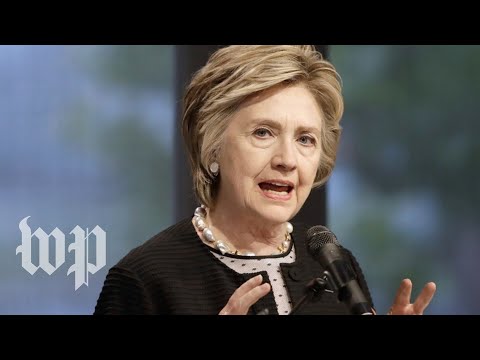 For more infomation >> Why a Hillary Clinton 2020 campaign is unlikely - Duration: 3:11.
  For more infomation >> From racist yearbook photo to 'infanticide' comments: Va. Gov. Northam's tumultuous week - Duration: 2:38.
  For more infomation >> North Dakota sends measles team to Washington - Duration: 1:34.
  For more infomation >> Pro-Brexit protester: Second referendum would be 'a sad day' for Britain - Duration: 2:24.


 For more infomation >> North Dakota sends measles team to Washington - Duration: 1:42.

 For more infomation >> Roger Stone Will Be Back In A Washington DC Court Friday - Duration: 0:27.


Không có nhận xét nào:
Đăng nhận xét